

At 19 she was discovered by French designers Paul Luis Orrier and Guy Laroche, who swept her away to Paris and launched her modeling career. From there Beth Sobol traveled the globe—from Florence to Geneva to Tokyo—where she learned the fashion production business “by osmoses.” Twenty years later, after working as an international model scout, Beth Sobol started CityStyle, (which focuses on upscale, trendy designers), is President of Sobol Fashion Productions, developed The Evening Show (an evening wear trade show in New York), and produces her crowning achievement, Miami Fashion Week.
Miami Fashion Week is the largest Latin American fashion event in the United States. Started in 1999, the first Miami Fashion Week (originally called Fashion Week of the Americas) was presented to an international audience of buyers, media and celebrities. Venezuelan designer, Carolina Herrera asked the organizers to form a fashion council to endorse Latin American designers – thus the birth of the Council of Latin American Fashion Designers, Inc. Miami Fashion Week was created to offer international exposure for Latin American and Caribbean designers. This May, over 30 designers, both established and emerging, from throughout North, South and Central America, Mexico, Europe and the Caribbean will present a preview of their latest collections.
Beth Sobol has worked with some of the biggest designers in the world and has succeeded in most every area of the unforgiving fashion industry -and she isn’t slowing down yet. Close friend and South Beach nightlife impresario Gerry Kelly says, “Beth put Miami on the world’s fashion map. She is very determined and focused and she has made a huge impact on Miami’s reputation in the eyes of the fashion world. We’re proud that she enables Miami to compete with the other fashion weeks around the world.”
Recently, as Beth was preparing for Miami Fashion Week 2005, we sat down with her to explore the woman behind these stellar accomplishments.
How Long have you lived in Miami?
I was born in Atlanta, but raised in South Florida since I was 4 years old – but I spent 12 years in Europe, Asia and South America modeling.
What was the most important lesson you learned during your time as a model?
Keep it professional. It’s the only way to succeed.
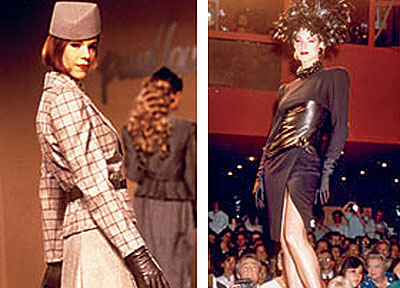
What was the most challenging part of modeling?
There really wasn’t one; modeling was very easy for me, but I was also very focused and knew that it was my job—the way I was going to earn my living. I was constantly motivated. I modeled for 20 years in over 28 countries and was always at the top of my game. You can’t do that if it isn’t in your soul.
Do you still stay in contact with people you modeled with?
Yes, I’m still in touch with several of my former modeling friends. We all live in different parts of the world and we are all doing very well now in our respective fields. One friend owns a dance school in Germany, another is an international modeling scout based in Paris, one is a jewelry designer in Monaco, and one’s an artist in New York City.
What skills did you acquire during your modeling days that have helped you in the world of business?
I learned the production business by osmoses. I was always paying attention to the action around me. I would hang out backstage with the technicians asking questions about their specific jobs and I was very observant of the choreographers, international show producers and directors that I worked with.
What prompted you to start Miami Fashion Week?
In 1996, I was hired to produce a two-day fashion event in Guayaquil, Ecuador for live television. After 15 days with 21 designers from 12 different countries, they asked me to do something for them in Miami—they all wanted to come to Miami but no one knew how. Two years later, I launched the first Miami Fashion Week.
Do you have a personal connection to the Latin community?
My former husband is Venezuelan and I lived in Caracas for 2 years. Oddly enough, the fashion industry found me within 2 weeks of arriving in Caracas, and soon thereafter I doing commercials and was booked for shows. It was there that I first started meeting Venezuelan designers, and that peaked my interest in learning more about Latin American fashion designers. Angel Sanchez was just starting out and making a name for himself in Caracas when I met him in 1993.
How do you decide which designers will participate in Miami Fashion Week?
There are requirements that the designers must meet: two years in business, design a minimum of two collections per year, 40 pieces per collection and be able to produce the collection on the U.S. time frame.
What’s the biggest difference between Latin designers and those from other parts of the world?
I think that Latin designers are more colorful. In general, they are very happy people and will have a party no matter what’s going on around the world. The economy may be in shambles and the government about to be overthrown, but many Latinos will decide to have a party to celebrate what they have, not what they don’t have. They love women and like to make them look as feminine as possible.
Are all designers who participate in Miami Fashion Week from Central and South America?
No, absolutely not. For the past 4 years we have had a host of international designers in the shows. Groups of designers from India, Italy, Spain, Portugal, Czech Republic, Canada and the US have participated in the past, and the 2005 event will welcome new designers from Serbia, Tanzania, Russia, France, as well as North, South and Central America and the Caribbean. The event did, however, start out with a Hispanic focus, but has developed over the years into a true international fashion event.
Do you ever have American designers participating in Miami Fashion Week?
Yes, Mary McFadden, Patricia Field, Charlie Lapson, and several Latin but American-based designers such as Oscar de la Renta, Carolina Herrera, David Rodriguez and Eduardo Lucero.
Do you still do model scouting?
Not really, it was taking too much of my time and I needed to focus more on Fashion Week. I do, on occasion, pass on an exceptional model to my friend in Paris who is scouting for several agencies around the world.
Have you discovered any models we would recognize?
Carolina Castro from Colombia was at Miami Fashion Week in 2000 and Oscar de la Renta, who was our special guest that year took her back to New York. She continued on to Paris and has done very well. Also, Grecia Polamares from Venezuela was at Miami Fashion Week in 1999, our first year and went on to Paris and New York.
When you first started in modeling and were traveling around the world, did you see yourself doing what you’re doing now, or did you have other ambitions?
Actually, I thought that I would open a modeling school and teach, but when I retired from modeling and returned to Florida, many of my old clients started asking me to produce their fashion shows. My first clients were Chanel, Fendi, Escada and St. John.
What advice would you offer to someone who wants to get started in Fashion?
Treat it as a business, if you want to make it a career. It takes a lot of hard work and dedication to keep at it. Even when 10 people tell you no, keep at it because the next person just might say yes! If you have the physical attributes required to be in this business, then go for it. But, if you are not able to fully support yourself financially within the first year, you are not cut out for it and should move on to something else. Don’t waste time, life is too short. Look for opportunities that will not only fulfill you professionally and financially, but will also feed your soul.
Miami Fashion Week kicks-off in May in Miami Beach. For location and show times visit www.miamifashionweek.com